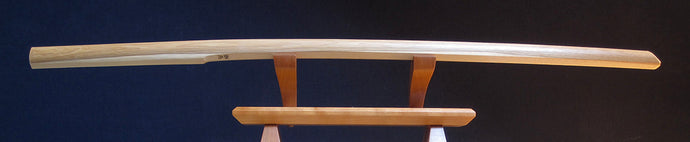
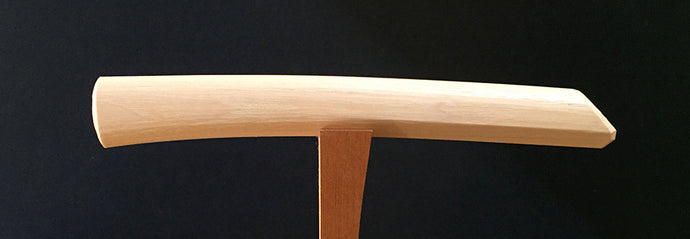
kenjutsu bokken
Basket Contents Checkout
 
About Kingfisher
Wooden Weapons
Display Stands
Hiking Stick
Accessories
Specials
Maintenance
Payment & Shipping
FAQ
Contact Kingfisher
kingfisher logo
 
Kingfisher WoodWorks LLC
 
Bokken, Jo
 
& other traditional Japanese wooden weapons
   
  Kingfisher WoodWorks of Wilder, Vermont manufactures handmade bokken (Japanese wooden sword), jo (Japanese staff) and related wooden weapons including accessories, cases and stands for both new and old school sword related martial arts including Aikido, Iaido, Kendo, Kenjutsu, and Jodo. The Kingfisher site includes historical information on each product, practical guidelines for correct sizing and secure server for online ordering worldwide. For more information about Kingfisher WoodWorks, see this link About Kingfisher


The Wooden Sword of Japan
 
bokken
 
Information on Choosing Bokken
bokken in kanji
 
While many cultures developed substitute weapons for use in developing martial skills in a practice environment, none have attained the degree of effectiveness, refinement and reserved austerity as the Japanese bokken, the wooden sword of the samurai. Unlike so many historical relics, not only did it attain a completely independent status as a weapon in its own right, it is still widely used by martial artists today.
 

The history of the Japanese sword spans about a thousand years. Over that time, the essential features of Japanese blades are remarkably uniform but we see differences, mainly nuances, in their shape. Some are longer by a few inches, some shorter, some with more pronounced curvatures, some heavy and others light in weight. Many bokken reflect these differences but we also see wooden swords that are not direct imitations of live blades. In fact, Japanese wooden swords are not generally intended to mimic the shape, weight or feel of a live samurai sword but instead intended to develop specific skills and facilitate specific movements.

For example, The thin Yagyu ryu bokken is lighter in weight than others and much lighter than a live blade. The medium Aikiken is somewhat lighter in weight but rather true in balance, curvature and proportion of a real sword. The heavy Kashima Bokken is similar in weight to a live blade but much different in shape, balance and proportion. The reason for these variations is that separate martial schools (ryu) emphasize different movements and these are better achieved with wooden swords of specific size and shape.
 
yagyu bokken cross section
Cross section of thin Yagyu bokken
aiki bokken cross section
Cross section of medium Aikiken
kashima bokken cross section
Cross section of thick Kashima bokken  
 
The Size and Proportion of Japanese Wooden Swords:
The classic size of the Japanese wooden sword is between 40 and 42" overall length with a 10 - 11" tsuka (hilt) with medium thickness, shape and balance characteristics - but there are variations. The history of samurai swords spans about 1000 years and changes came with evolving conditions.

bokken size


Bokken of significantly different size are used for specific purposes. The rather short wooden sword of the Katori Ryu is specialized to that school and the extremely long tsuka of the kenjutsu bokken also has its roots in a particular methodology. The size of specialized bokken are largely determined by the conventions of those schools and while there may be some variations related to individual users, the overall proportions of these weapons are not necessarily customized to any large degree or adapted specifically to fit a particular body size.


Point (kissaki) Designs:

Point design is also associated with specific bokken.
 
bokken with blunt point
bokken with chisel point
bokken with sword point
Blunt point - used with thicker bokken of the Iwama style of Aikido
Chisel point - used with Aiki-ken and Katori bokken
Sword point - used with hand cut Shinto, Yagyu and Kenjutsu bokken.
 
The three major point designs of Japanese Wooden Swords are shown above. All variations of classical wooden weapons are based upon these three major shapes. They have their origins in the wooden swords of the old schools (koryu) and are paired with specific weapons. For example, the blunt point is the simplest and dates to the oldest of the classic styles and is now used as well in the the more modern Iwama branch of Aikido. The chisel point is a good all around design with strong geometry. It falls stylistically between the simple truncated blunt point and the realistic sword style point. The sword style point is used in the shinto bokken, an excellent choice for Iaido practice and general Aikido use as well.
 
For more technical information on weights and axis dimensions of specific products see this link: Bokken Specifications
 
Role of the Tsuba (hand guard):
Some traditional schools use tsuba and others don't. For example, tsuba are used with the Kashima Bokken but not with the Iwama bokken. In Kashima Ryu techniques, the fingers can be badly smashed if not protected by the hand guard. In the Iwama style of Aikido however, which emphasizes weapons practice as it relates to open handed techniques, the user trains to rely on correct movement and posturing rather than the tsuba for protection. The tsuba is also used for less obvious reasons. In certain situations the sheathed sword was partially drawn and the samurai used the tsuba itself as a non lethal pressure point weapon. Some of these esoteric techniques are still practiced today with wooden swords. It is important for the beginning student to consider the tsuba based on the correct use of the weapon, not the perceived esthetics of its effect on the sword. In general, it is best to use a tsuba when practicing in a dojo that uses them but not otherwise.
bokken, tsuba, wooden martial art sword
 
close up of bokken, martial art sword with tsuba transition
Some bokken have a clear transition which acts as a stop for the tsuba and defines the end of the hilt and the beginning of the blade. These wooden swords may be used with or without tsuba. If the use of a guard is anticipated, it is recommended to order the bokken and tsuba together since guards are fitted to individual bokken.  
close up of bokken with smooth transition

Others have a smooth transition from tsuka (hilt) to blade and are not used with tsuba.


Wood Choices:

There are only a handful of wood choices suitable for Japanese wooden swords. Most others are too weak or too soft or too brittle. In fact, there are only two readily available materials - American Appalachian Hickory (Impact Hickory) and Japanese White Oak (Shiro Kashi) that are recommended for routine practice. The rest (some are quite hard and beautiful) are nonetheless prone to brittleness and originate from poorly managed tropical sources. Kingfisher uses Appalachian Hickory which has some distinct advantages over other wood choices. It is extremely tough and doesn't get brittle over time. If any warpage occurs due to humidity swings, it can be straightened quite easily. It has a beautiful grain pattern and tactile feel. With proper break in and maintenance, it will have a very long useful life. Most importantly, Kingfisher grades lumber individually so that the user can choose a weapon specific to his or her budget requirements and easily choose between quality levels and prices.

For more information on the strength of wood used in wooden weapons - see this link: Woods For Training Weapons and The Strength of Wood. also, there is some interesting additional information on hickory in our hiking stick site.
 
Bokken Customizations:
Choosing a bokken can be confusing. Being aware of the fact that there are many different styles of bokken, there are a few important guidelines that will help the martial artist to choose a suitable wooden sword. It is better to find a standard wooden sword design that fits your needs rather than order a completely customized bokken. In the event that a standard wooden sword does not fit a particular need, it is easy in most cases to make small adjustments to a standard shape. First and foremost, the style of bokken is often determined by the conventions of a particular school or tradition and it's important to first ask a senior student or the chief instructor in your dojo about this and how it relates to your practice.
 
Information on Choosing a Jo
Jo kanji
 
The Wooden staff of Japan

Jo staff

The wooden staff of Japan, or "Jo", is a cylindrical straight stick of unassuming character with a length ranging from about 50" to 56" and a diameter of about 1". It is used alone in kata or paired with other Jo and closely linked historically with the Japanese sword. Staffs are inconspicuous and, owing to their elegance and simplicity, are preferred by some martial artists above all other weapons. An understanding of its uniqueness in Japanese martial art history and an insight into its original character, usage and dimensions is related here by Wayne Muromoto in this exerpt of an excellent article in the Koryu Books online archives.
 

Muso Gonnosuke and the Shinto Muso-ryu Jo
by Wayne Muromoto

If we can believe the legends--and there are more legends than facts concerning these two martial artists--the only person to beat Miyamoto Musashi in a duel was someone as outlandish and eccentric as he was. And to top it off, he did it with a wooden stick. In so doing, Muso Gonnosuke Katsuyoshi gave birth to a martial arts system that would elevate the humble wooden staff to one of the preeminent weapons of the bugei of Japan. We know very little that can be verified about the actual life of Muso Gonnosuke, and the little that we do know must be tempered with the knowledge that much of what has been written has been colored and embellished by later writers to make for exciting reading. Nishioka Tsuneo, head of the Seiryukai organization, cautions that many of the legends purporting Gonnosuke to be a colorful braggart originated long after his actual lifetime. "We just don't know that much about him," Nishioka says. In any case, records note that Gonnosuke's original family name was Hirano, and that he went by the given name of Gonbei early in his life. He was supposed to be a distant descendant of Kiso Kanja No Taiyu Kakumei, a retainer of the famous general, Kiso Yoshinaka. Gonnosuke studied the Tenshin Shoden Katori Shinto-ryu under Sakurai Ohsumi No Kami Yoshikatsu, then he studied the Kashima Jikishinkage-ryu, learning its secret method called the "ichi no tachi". According to legends, Gonnosuke thereupon engaged in various duels throughout Japan to test his skills, never losing any of them until he met Miyamoto Musashi. To be sure, there were wooden staff arts before Gonnosuke's time. The Tenshin Shoden Katori Shinto-ryu had bojutsu methods using the rokushaku bo (six-foot staff), as did the Sekiguchi-ryu, Bokuden-ryu and Takeuchi-ryu (or, as it is alternatively called, Take-no-uchi-ryu). If we follow the lineage line charted in the Bugei Ryuha Daijiten, then Gonnosuke was a student of a teacher of the Tenshin Shoden Katori Shinto-ryu, which is why his style, the Shinto Muso (or Shindo Muso) -ryu contains the appellation Shinto (Way of the Gods).


The Duel With Musashi and Mount Homan

The first duel with Musashi occurred in Keicho 10 (1605), just five years after the Battle of Sekigahara put an end to most internal civil wars and heralded the start of the two-centuries-long Tokugawa peace. The event was supposed to have taken place in Akashi, Harima province. There are different versions of the first duel. A rather silly but entertaining one is concocted by Yoshikawa Eiji in the novel Miyamoto Musashi. However, the first records of such a duel is found in the Kaijo Monogatari, written in 1629. The gist of its version was subsequently published in the Jodo Kyoshi. The following is a synopsis of that episode: There was a heihosha (martial artist) named Miyamoto Musashi. He engaged in duels from the age of 16 and was in about 60 matches. In the sixth month, in Akashi, Harima province, he met Muso Gonnosuke, who was a six foot tall strapping warrior. Gonnosuke was armed with an odachi (a long sword), a two layer overcoat with sleeves, and a haori with a large hi no maru (rising sun). On his lapels were written: "The best martial artist in the land" (heiho tenka ichi), and "Nihon Kaizan Muso Gonnosuke."...Gonnosuke was surrounded by about six deshi followers who accompanied him on a journey to Kyushu. He boasted to Musashi that no one was his equal. In his travels, he had apparently encountered Musashi's father, Shinmen Munisai, a master of the jutte (truncheon)."I have seen your father's techniques, but I haven't seen yours," he said, goading Musashi. (Shinmen) Miyamoto Genshin Musashi was irritated. He was in the middle of carving a willow branch and replied, "If you saw my father's techniques, I am no different."Gonnosuke pressed the issue, badgering Musashi to show his martial arts off for the benefit of Gonnosuke's students."My heiho is not for display," Musashi snapped. "No matter how you attack me, I'll stop it. That's all there is to my heiho. Do what you will, with any technique."Gonnosuke pulled out a four-shaku (a shaku is roughly equivalent to an English foot) wooden sword from a brocade bag. (To draw a comparison, the usual practice sword is but a little longer than two shaku.) He attacked Musashi without any formalities. Musashi stood up from his crouch. With what seemed to be very little effort, he forced Gonnosuke back across the tatami mat room with his willow branch and, pressing him against a wall, struck him lightly between the eyebrows. Another slightly different version of that first duel appears in the Honcho Bugei Koden. The book was originally compiled in Shotoku 4 (1714). Watatani, in his edited and annotated version of the Honcho Bugei Koden, notes that the Nitenki, a compilation of Musashi's exploits by his followers, places the event in Edo, but this appears to be a later corruption. The earliest record of this duel appeared in the Kaijo Monogatari, but 26 years after Musashi's death, and it places the battle in Akashi. The description of the duel in the Honcho Bugei Koden is more or less the same as in the Kaijo Monogatari, with some minor differences. In this version, Musashi was carving the willow branch into a toy bow used for sideshow games. It was a thin piece of wood only two shaku or so in length. Musashi invited Gonnosuke into a seven and a half mat room. In actuality, it is probable that Musashi beat Gonnosuke by using his special two-swords technique (nito), trapping Gonnosuke's weapon in an x-block, or juji dome, with his long and short swords. Musashi was able to trap an opponent's weapon with the block, forcing the attacker to either give up or retreat and face an immediate counter-attack. Gonnosuke must have been a large, strapping warrior, if he wielded such a large bokken or bo. A wooden sword attributed to Gonnosuke at Chikuwa Shrine is over four shaku, nine sun and two bu (over four feet) long. Gonnosuke's jo, if measured by the width of his outstretched hands held out to his sides, must have been a bit longer than the standard jo used nowadays. Whatever the case may be, Gonnosuke lost the first duel. Mortified, he withdrew to Homangu, part of the Kamado Shinto shrine atop Mount Homan, in Chikuzen province, (present-day Dazaifu, Fukuoka Prefecture) Kyushu. For 37 days he meditated and performed rites of austerity. On the last night night, while praying in front of an altar, he collapsed and had a divine vision. In one version, a heavenly child appeared and said, "Holding a round log, know the suigetsu (an attack point on the body)." The cryptic vision compelled Gonnosuke to whittle a short staff about four shaku, two sun and one bu in length (128 cm.). This was longer than the standard tachi long sword of that period, which was three shaku, two sun and one bu, but shorter than the long rokushaku bo. By taking advantage of the short staff's ability to shift rapidly in the hands of a skilled artist, Gonnosuke was able to beat Musashi in a second duel. It is unclear how Gonnosuke did that, but the use of the jo in present-day Shinto Muso-ryu practice might give us a hint. If a jo is blocked by a juji-dome, it is an easy matter to quickly flip the jo out of the block and in the same motion strike a kyusho (weak point) on the swordsman's body. Gonnosuke also created a system of five secret methods (hiden gyo-i) that incorporated all the techniques of his new jo style. Gonnosuke managed to defeat Musashi without causing him great harm. Gonnosuke became martial arts instructor to the Kuroda clan, located in northern Kyushu. Muso Gonnosuke, profoundly changed by his encounter with Musashi and by the divine vision atop Mount Homan, had created a preeminent staff art, the Shinto (or Shindo) Muso-ryu jojutsu. The Heavenly Way of Muso's staff...

Jo Sizing Information
drawing of jo
 
It is interesting to note that by these accounts, Muso's "post enlightenment" Jo has a specific length and seems not to be tailored (as were his earlier huge wooden swords) to the fact that he was a large man. The Jo of Muso Gonnosuke and that of the school that bears his name, the Shinto Muso Ryu, is 4 shaku, two sun and one bu - or about 50 1/4" in length with a diameter of 8 bu - or 15/16". Kingfisher offers this size as a standard option. Many martial artists however, use Jo tailored to their physical height and certain dojo and organizations adopt other size guidelines as shown below.
 
A general rule for Jo length is floor to armpit, standing barefoot. Notice that the measurement is made with the arm in a normal relaxed position.
     
 
As always in choosing a wooden weapon, the most important first step for a newcomer is to find out what is preferred in the their dojo. In choosing your jo, all situations are different but we would suggest that customizations in size be generally conservative eg, a taller practioner might order a jo up to 53 or 54" jo and a shorter person might simply stick to the orginal parameters of the shinto muso ryu rather than ordering a very short jo. Excessively long or custom made extra thick jo, unless expressly required by an instructor, will certainly not be welcomed in most weapons practice.
 
The Role of Diameter
 
thickness of jo Small differences in diameter affect the feeling of thickness and overall weight of these shapes. A 51” Jo, at 1” diameter, will feel noticeably fuller in the hand than one of 15/16" even though the increase in diameter is incremental.  
©2011 kingfisherwoodworks.com
We do not allow reprinting our content on another web site or publication without permission but you may link to our site without special permission.
©2012 kingfisherwoodworks.com
We do not allow reprinting our content in any form without advance written permission.
 
KINGFISHER WOODWORKS LLC - PO BOX 734 - WILDER, VERMONT 05088 tel 802 295 9908